Jane Pinheiro
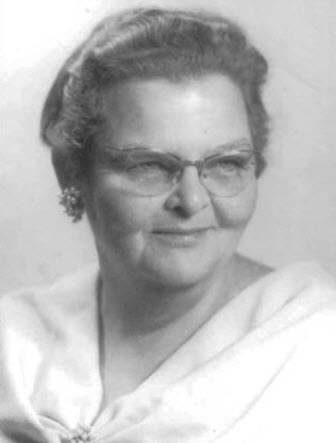
The interpretive center at the California State Poppy Reserve west of Lancaster, California, is named in honor of the late Jane S. Pinheiro, the tireless conservationist who worked diligently to help make the park a reality.
Born Jane Seymour in Denver, Colorado, on September 9, 1907, she spent her youth in Salt Lake City, where she received her teaching credentials from the University of Utah. In the late 1920s she and her mother, Nellie Flick Seymour, moved to Pasadena, California, where Mrs. Seymour ran a boarding house. One of the guests was a young dairyman, Joseph Pinheiro, a native of the Azores. He and Jane were married in 1930.
In 1940 the Pinheiros moved to the Antelope Valley, where Joe worked at Pancho Barnes’ “Happy Bottom Riding Club,” just outside Edwards AFB, with famed test pilot Chuck Yeager in attendance most days. During this time Jane became intrigued with the desert plants and began to sketch and paint them. A self-taught artist and botanist, she became an authority on local desert flora. Her watercolor renditions are so botanically correct that they are used for identification purposes. Her paintings hang across the country; over 100 of them hang in the Theodore Payne Foundation and the Native Plant Guild. She also served as a consultant to Sunset magazine and other publications, as well as to The Nature Conservancy.
The Wildflower Preservation Committee of the Lancaster Women’s Club raised funds to purchase the 163 Pinheiro paintings presently housed at the interpretive center. They framed them with oak and used acid-free mounting according to state specifications. Protective padded envelopes were made to guard them in storage and while transporting them.
The Antelope Valley California Poppy Reserve was dedicated in 1976—an event Jane attended. The interpretive center was dedicated on April 17, 1982, after Jane’s death, but her husband, Joe, lived to attend the event and died shortly thereafter. Pinheiro’s accomplishments are too numerous to summarize fully. An overview shows that she and a neighbor, Edna Mae Ling, my grandmother, started the annual Quartz Hill Almond Blossom Festival in 1950. She served for ten years on the Board of Directors of the Antelope Valley Fair. As early as 1950, Jane foresaw the necessity of water development in the valley. She was instrumental in the formation of the Feather River Project, later known as the Antelope Valley–East Kern Water Agency (AVEK). In 1949 Jane began work to establish what later became Antelope Valley Medical Center. After it became a hospital district, she served as its first secretary and remained on the board until her death.
Jane did whatever she thought necessary to protect the natural beauty of the desert. Toward the preservation of Joshua trees, she enlisted the support of Assemblyman Allen Miller. The 2,720-acre Joshua Tree State Park became a reality in 1960. Later, to avoid confusion with Joshua Tree National Monument, the name was changed to Saddleback Butte State Park. It is located on Avenue J at about 170th Street East, a short distance northeast of the Antelope Valley Indian Museum, another part of the state park system.
Pinheiro was instrumental in establishing at least eight wildflower and wildlife sanctuaries in the Antelope Valley, ranging in size from 100 to 455 acres. Her fund-raising efforts were directed toward Red Rock Canyon, Morongo, and Sand Ridge as well. To assist the many visitors who came to the Antelope Valley to view the wildflowers each spring, Jane decided in 1963 to establish an information center. At first this was on Sierra Highway, then at the Fairgrounds, and has since been established at the Lancaster Museum of Art and History on Cedar Avenue. Her nearly three-dimensional watercolors, annotated with accurate botanical legends, were on display together with informational books and maps. Eventually the Women’s Club took over this project. Under Pinheiro’s guidance, the Antelope Valley Arts Association (now the Antelope Valley Allied Arts Association) was formed in 1946 to bring together people with shared interests, sponsor exhibitions, and plan programs. The formation of the Antelope Valley Universalist Fellowship Church, of which she was a member, was due in large part to Jane’s vigorous efforts.
Jane was an active lobbyist in Sacramento on conservation issues and a friend of many political personages, including presidents and governors. Although she suffered ill health during the last decade of her life, she never complained and continued to work for the preservation of her beloved desert. She brought great honor to the community when she earned two national awards in conservation: the coveted National Oak Leaf Service Award from The Nature Conservancy and the Sol Feinstein Environmental Award. She was flown to Washington, D.C., and New York City, respectively, to receive these presentations.
It is with amazement that we view this great lady’s accomplishments. It is even more astounding when we realize that she did all this on a very limited income. Her husband was a blue-collar worker who never earned more than $8,000 a year. He was, however, a continual pillar of support for Jane, who often said that without Joe she could not have made such great strides in the development of the Antelope Valley. Jane died October 14, 1978; her beloved Joe, in August 1982. Having no children, they left their estate to the Theodore Payne Foundation. The final chapter was closed on an active conservationist who was listed in six Who’s Who volumes—Who’s Who of American Women, Who’s Who in California (1958), Who’s Who in the West, Outstanding Civic Leaders of America, World’s Who’s Who of Women, and Two Thousand Women of Achievement. Her living legacy endures in her paintings, the organizations she founded, and the parks she helped to establish.