Velociraptor: The Swift Thief
Velociraptor is one of the most famous dinosaurs in popular culture, but the real animal was quite different from its Hollywood portrayal. This small, feathered predator was a highly intelligent hunter that used speed, agility, and possibly pack tactics to survive in the harsh deserts of Late Cretaceous Mongolia.
When Did Velociraptor Live?
Velociraptor lived during the Late Cretaceous period, approximately 75 to 71 million years ago. Its fossils have been found primarily in Mongolia and China, in what were once arid, desert-like environments with seasonal sand dunes.
Quick Facts
- Period: Late Cretaceous (75-71 million years ago)
- Location: Mongolia and China
- Length: 6.5 feet (2 meters)
- Height: 1.6 feet tall at the hips
- Weight: 30-33 pounds (about the size of a large turkey)
- Diet: Carnivore (small prey hunter)
Size: The Hollywood Myth
One of the biggest misconceptions about Velociraptor comes from the Jurassic Park films, which depicted them as human-sized pack hunters. In reality, Velociraptor was roughly the size of a large turkey, standing only about 1.6 feet tall at the hip and weighing around 30 pounds.
The movie's "raptors" were actually based more closely on Deinonychus, a larger relative from North America that stood about 3-4 feet tall. The filmmakers chose to use the name "Velociraptor" because it sounded more dramatic.
Feathered, Not Scaled
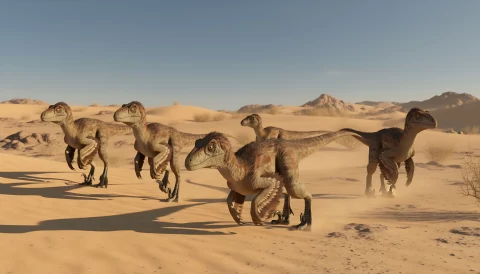
Modern paleontological evidence confirms that Velociraptor was covered in feathers. Quill knobs (bumps where feathers attach to bone) have been found on Velociraptor forearm fossils, proving beyond doubt that these dinosaurs were feathered. However, they couldn't fly—their arms were too short and their feathers were likely used for display, temperature regulation, and possibly to protect eggs while brooding.
This discovery fundamentally changed how we visualize these dinosaurs. Instead of the scaly, reptilian creatures of early depictions, Velociraptor would have looked more like a large, predatory bird with a long tail and wicked claws.
The Killing Claw
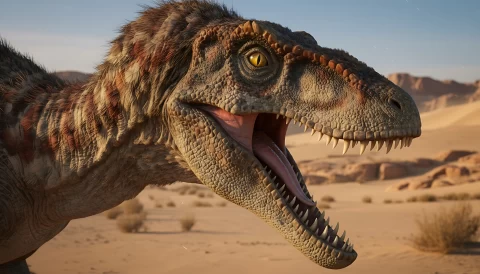
The most fearsome weapon in Velociraptor's arsenal was the large, sickle-shaped claw on the second toe of each foot. This 2.6-inch curved talon could be held off the ground while running, then deployed during an attack.
How Did They Use It?
Scientists once believed Velociraptor used its killing claw to disembowel prey. However, recent studies suggest a different hunting strategy—the claw was more likely used to pierce vital organs or major blood vessels, or to help the predator maintain its grip on struggling prey while it delivered killing bites.
The famous "Fighting Dinosaurs" fossil from Mongolia shows a Velociraptor locked in combat with a Protoceratops, with the raptor's killing claw embedded in the neck area of its prey. Both animals died in this position, likely buried by a sudden sandstorm, preserving this ancient battle for 75 million years.
Intelligence and Pack Hunting
Velociraptor had a relatively large brain for its body size, suggesting it was among the more intelligent dinosaurs. Its brain-to-body ratio was similar to modern birds, and its large olfactory bulbs indicate it had an excellent sense of smell.
Whether Velociraptor hunted in packs remains controversial. While the Jurassic Park films popularized the image of coordinated raptor pack attacks, fossil evidence for this behavior is limited. Some paleontologists believe they were more likely solitary hunters or loose social groups that gathered opportunistically, similar to modern Komodo dragons.
Speed and Agility
The name "Velociraptor" means "swift thief," and the dinosaur certainly lived up to its name. Biomechanical studies suggest Velociraptor could run at speeds up to 24 mph (40 km/h) in short bursts. Its long, stiff tail acted as a counterbalance, allowing it to make sharp turns at high speed while pursuing prey.
This agility, combined with sharp teeth, powerful jaws, and those distinctive killing claws, made Velociraptor a formidable hunter despite its small size. It likely preyed on small mammals, lizards, and smaller dinosaurs.
Discovery and Cultural Impact
Velociraptor was first discovered in 1923 by paleontologist Peter Kaisen during an American Museum of Natural History expedition to the Gobi Desert. The dinosaur remained relatively obscure until Michael Crichton featured it in his 1990 novel "Jurassic Park," and Steven Spielberg's 1993 film adaptation made it a household name.
Despite the many scientific inaccuracies in its portrayal, Jurassic Park sparked renewed public interest in dinosaurs and helped fund paleontological research. Velociraptor has since become an icon of dinosaur intelligence and predatory prowess.
Bring Velociraptor to Your Desktop
Experience the swift predator with our stunning 4K wallpapers.
Conclusion
Velociraptor may not have been the giant pack-hunting monster of cinema, but the real animal was no less fascinating. As a small, feathered, intelligent predator with a distinctive killing claw, Velociraptor represents the incredible diversity of predatory dinosaurs. It reminds us that in nature, success doesn't always come from size—sometimes speed, intelligence, and specialized weapons are all you need to thrive.