Utahraptor: The Real Jurassic Park Raptor
While Velociraptor gets all the Hollywood fame, Utahraptor was the true giant of the raptor family. Discovered just as Jurassic Park was being filmed, Utahraptor was actually the size depicted in the movie—a massive, deadly predator that stood as tall as a human and weighed as much as a grizzly bear.
When Did Utahraptor Live?
Utahraptor lived during the Early Cretaceous period, approximately 135 to 130 million years ago. It roamed the ancient floodplains and forests of what is now Utah, making it one of the oldest known dromaeosaurids (raptor family dinosaurs).
Quick Facts
- Period: Early Cretaceous (135-130 million years ago)
- Location: Utah, USA
- Length: 23 feet (7 meters)
- Height: 6 feet tall at the hips
- Weight: 1,000-1,500 pounds
- Diet: Carnivore (apex predator)
The Largest Raptor Ever
Utahraptor was the largest known dromaeosaurid, dwarfing famous relatives like Velociraptor and Deinonychus. Standing 6 feet tall at the hip and stretching 23 feet from nose to tail, Utahraptor was roughly the size of a modern polar bear—and just as dangerous.
Its killing claw was proportionally massive, measuring up to 9-10 inches along its outer curve. This weapon could deliver devastating slashing attacks capable of inflicting fatal wounds on prey much larger than itself.
Built for Power
Unlike its smaller, more agile relatives, Utahraptor was built like a tank. Its robust skeleton and powerful musculature suggest it was less about speed and more about raw power. While Velociraptor pursued small prey with quick strikes, Utahraptor likely took down large herbivorous dinosaurs through sustained, powerful attacks.
Hunting Strategy
Paleontologists believe Utahraptor may have hunted in coordinated groups. A remarkable fossil discovery called the "Utahraptor megablock" contains at least nine Utahraptor individuals along with a large herbivore, all preserved together. This suggests they may have been pack hunting or scavenging together when they were suddenly trapped and killed, possibly in quicksand.
If Utahraptor did hunt in packs, they would have been among the most formidable predators of their time—capable of bringing down prey as large as young sauropods.
Feathered Giant
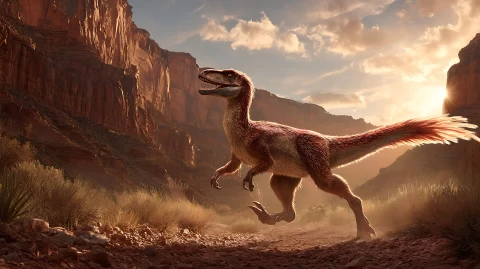
Like other dromaeosaurids, Utahraptor was almost certainly covered in feathers. While no direct fossil evidence of feathers has been found on Utahraptor itself (due to the rarity of preservation conditions needed), its close relatives all show evidence of plumage, making it virtually certain that Utahraptor was feathered as well.
These feathers wouldn't have been for flight—Utahraptor was far too large and heavy. Instead, they likely served for display, temperature regulation, and possibly to shield eggs and young from the elements.
The Perfect Timing
In one of paleontology's most remarkable coincidences, Utahraptor was discovered in 1991—just as Jurassic Park was in production. The filmmakers had already decided to make their "Velociraptors" human-sized for dramatic effect, not knowing that such a creature actually existed.
When news of Utahraptor's discovery broke, it vindicated the film's creative decisions. As paleontologist James Kirkland (one of Utahraptor's discoverers) noted, "We found a raptor the size of the ones in Jurassic Park. Hollywood got it right by accident."
A Mysterious Predator
Despite its impressive size and fearsome reputation, Utahraptor remains somewhat mysterious. Complete skeletons are rare, and much of what we know comes from fragmentary remains. The ongoing excavation of the "megablock" fossil—a massive sandstone block containing multiple individuals— promises to reveal much more about this giant predator's biology and behavior.
Bring Utahraptor to Your Desktop
Experience the giant raptor with our stunning 4K wallpaper.
Conclusion
Utahraptor represents the apex of dromaeosaurid evolution—a massive, powerful predator that combined the intelligence and killing tools of smaller raptors with the size and strength to take down truly large prey. While Hollywood made Velociraptor famous, Utahraptor was the real giant of the raptor world—a feathered nightmare that ruled the Early Cretaceous of North America.