Tyrannosaurus Rex: The King of the Cretaceous
Few dinosaurs capture the imagination quite like Tyrannosaurus Rex. This apex predator dominated the landscapes of North America during the Late Cretaceous period, approximately 68 to 66 million years ago. With its massive skull, powerful jaws, and surprisingly small arms, T-Rex remains one of the most studied and celebrated dinosaurs in paleontology.
When Did T-Rex Live?
Tyrannosaurus Rex lived during the Late Cretaceous period, specifically during the Maastrichtian age. This was the final chapter of the Age of Dinosaurs, ending with the catastrophic asteroid impact that caused the mass extinction event 66 million years ago. T-Rex was among the last non-avian dinosaurs to walk the Earth.
Quick Facts
- Period: Late Cretaceous (68-66 million years ago)
- Location: Western North America
- Length: Up to 40 feet (12 meters)
- Height: 12-20 feet tall at the hips
- Weight: 8-14 tons
- Diet: Carnivore (apex predator)
The Perfect Predator
T-Rex possessed one of the most powerful bites in the animal kingdom—estimated at 12,800 pounds of force. Its massive skull, measuring up to 5 feet long, housed 60 thick, conical teeth designed for crushing bone. Unlike the blade-like teeth of other predators, T-Rex teeth could pulverize prey, allowing it to consume nearly every part of its kill.
Hunting Strategy
Scientists debate whether T-Rex was primarily a hunter or a scavenger. Current evidence suggests it was likely both—an opportunistic predator that would hunt when necessary but wouldn't pass up an easy meal. Its excellent sense of smell and binocular vision made it a formidable tracker, while its powerful legs allowed it to reach speeds of 12-18 mph despite its enormous size.
Those Tiny Arms
Perhaps the most famous feature of T-Rex is its surprisingly small arms, measuring only about 3 feet long. While they appear comically small compared to its massive body, recent research suggests these arms were far from useless. Each arm could lift approximately 400 pounds, and they may have been used to grip prey, help the dinosaur stand up, or hold struggling prey close to its jaws.
Habitat and Environment
T-Rex roamed the western interior of North America, in what is now the Hell Creek Formation spanning Montana, North and South Dakota, and Wyoming. During the Late Cretaceous, this region was a subtropical environment with vast floodplains, river deltas, and coastal lowlands. The climate was much warmer than today, with no polar ice caps.
This rich ecosystem supported a diverse array of life, including:
- Herbivorous dinosaurs like Triceratops and Edmontosaurus
- Smaller predators and scavengers
- Early mammals, birds, and crocodilians
- Lush vegetation including ferns, conifers, and flowering plants
Discovery and Legacy
The first T-Rex fossils were discovered in 1902 by paleontologist Barnum Brown in Montana. Since then, approximately 50 partial skeletons have been found, making T-Rex one of the best-understood dinosaurs. Famous specimens like "Sue" (the most complete T-Rex ever found) have provided invaluable insights into the biology and behavior of these magnificent creatures.
Today, T-Rex continues to captivate both scientists and the public. New discoveries regularly challenge our understanding—from evidence of feathers on related species to insights about their growth rates, social behavior, and even the color of their world.
Bring T-Rex to Your Desktop
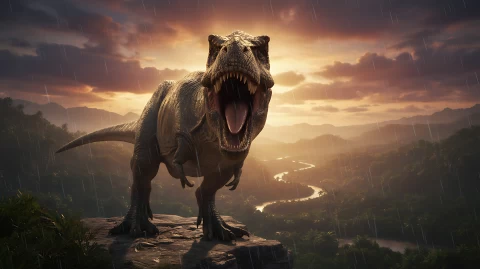
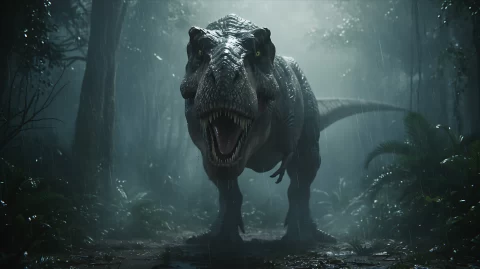
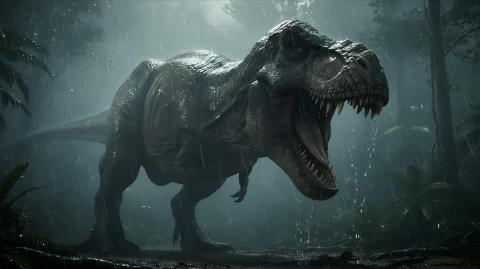
Experience the majesty of Tyrannosaurus Rex with our stunning 4K wallpapers. Each image captures the power and presence of this legendary predator.
Conclusion
Tyrannosaurus Rex stands as a testament to the incredible diversity and power of prehistoric life. As the undisputed king of the Late Cretaceous, T-Rex represents the pinnacle of theropod evolution—a perfect storm of size, strength, and predatory prowess that has never been matched on land since.
Whether you're a paleontology enthusiast or simply fascinated by these ancient giants, T-Rex continues to inspire wonder and curiosity about the world that existed millions of years before humans walked the Earth.