Triceratops: The Three-Horned Tank
With its massive head, three horns, and enormous bony frill, Triceratops is one of the most recognizable dinosaurs ever discovered. This herbivorous giant was one of the last non-avian dinosaurs to exist, living alongside T-Rex in the final chapter of the Age of Dinosaurs.
When Did Triceratops Live?
Triceratops lived during the Late Cretaceous period, approximately 68 to 66 million years ago. It was among the last dinosaurs to walk the Earth before the catastrophic asteroid impact that ended the Mesozoic Era. Triceratops fossils are found in the same Hell Creek Formation that yielded T-Rex, showing these two giants shared the same ecosystem.
Quick Facts
- Period: Late Cretaceous (68-66 million years ago)
- Location: Western North America
- Length: 26-30 feet (8-9 meters)
- Height: 10 feet tall at the hips
- Weight: 12,000-16,000 pounds (6-8 tons)
- Diet: Herbivore (plant-eater)
The Iconic Horns and Frill
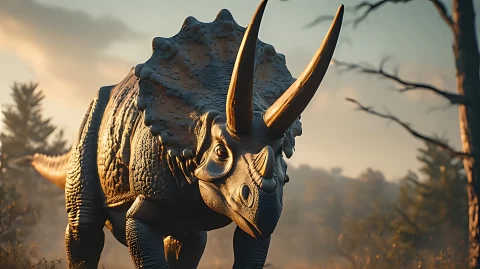
Triceratops means "three-horned face," referring to the two large horns above its eyes and the shorter horn on its nose. The brow horns could grow over 3 feet long and were formidable weapons. Behind its head sat a massive bony frill that could span over 6 feet across.
What Were They For?
Scientists believe the horns and frill served multiple purposes:
- Defense against predators: The horns were deadly weapons against T-Rex and other predators
- Combat between rivals: Fossil evidence shows healed wounds on frills, suggesting Triceratops fought each other for dominance or mates
- Display: The frill may have been brightly colored for species recognition and courtship displays
- Thermoregulation: Blood vessels in the frill could have helped regulate body temperature
Built Like a Tank
Triceratops was one of the most heavily built dinosaurs, with a massive skull that could weigh over 2,000 pounds—one-third of its total body weight. Its body was stocky and muscular, supported by four powerful legs. The front legs were especially robust, bearing much of the weight of that enormous head.
Despite its bulk, Triceratops could likely move fairly quickly when threatened. Biomechanical studies suggest it could charge at speeds up to 20 mph—fast enough to make it a dangerous opponent for any predator.
The T-Rex Connection
Triceratops and T-Rex had one of the most famous predator-prey relationships in prehistory. Numerous Triceratops fossils show bite marks that perfectly match T-Rex teeth, while some T-Rex fossils show wounds consistent with Triceratops horns.
These battles must have been spectacular. A charging Triceratops could deliver devastating horn strikes, while T-Rex's bone-crushing bite could pierce Triceratops' thick hide. Fossil evidence shows both species sometimes won and sometimes lost these encounters.
A Formidable Defense
When threatened, Triceratops would likely lower its head, presenting a wall of horns to attackers— similar to how modern rhinos defend themselves. The bony frill protected its neck, one of the most vulnerable areas. For a predator like T-Rex, attacking an adult Triceratops was a dangerous proposition that could result in fatal goring.
Diet and Lifestyle
Triceratops was a low-browsing herbivore with a powerful beak and hundreds of teeth arranged in batteries. These dental batteries were constantly replacing worn teeth, allowing Triceratops to process tough, fibrous vegetation like palms and cycads.
Evidence suggests Triceratops may have lived in herds, at least occasionally. A bone bed in Montana contains remains of several individuals who died together, possibly in a flood or drought. Living in groups would have provided additional protection against predators, with adults forming a defensive circle around vulnerable young.
An Abundance of Fossils
Triceratops is one of the most commonly found dinosaurs in North America. Hundreds of specimens have been discovered, including many nearly complete skulls. This abundance has made Triceratops one of the best-understood dinosaurs, providing detailed insights into its growth, variation, and lifestyle.
Interestingly, scientists once thought that juvenile Triceratops with different frill shapes were separate species (like "Torosaurus"). However, recent studies suggest these were likely just young or different-aged Triceratops, showing how the frill changed shape as the animal matured.
Bring Triceratops to Your Desktop
Experience the three-horned giant with our stunning 4K wallpaper.
Conclusion
Triceratops stands as one of the ultimate success stories of dinosaur evolution. As one of the last and largest ceratopsians, it represented the peak of horned dinosaur diversity. Its ability to defend itself against even the mighty T-Rex, combined with its abundance in the fossil record, shows just how successful this magnificent creature was. Though it disappeared in the mass extinction 66 million years ago, Triceratops remains an enduring icon of the Age of Dinosaurs.