Protoceratops: The Desert Dweller
Long before Triceratops dominated North America, its smaller ancestor Protoceratops thrived in the desert environments of ancient Mongolia. This sheep-sized dinosaur may have been small, but it played a crucial role in understanding ceratopsian evolution and gave us one of paleontology's most famous fossils—the "Fighting Dinosaurs."
When Did Protoceratops Live?
Protoceratops lived during the Late Cretaceous period, approximately 75 to 71 million years ago. It inhabited the harsh desert environments of what is now the Gobi Desert in Mongolia and China, where it had to survive in a landscape of sand dunes, seasonal water sources, and extreme temperatures.
Quick Facts
- Period: Late Cretaceous (75-71 million years ago)
- Location: Mongolia and China (Gobi Desert)
- Length: 6 feet (1.8 meters)
- Height: 2 feet tall at the shoulders
- Weight: 400 pounds (about the size of a sheep)
- Diet: Herbivore (plant-eater)
The Proto-Horned Face
Protoceratops means "first horned face," though it's a bit of a misnomer—it didn't actually have true horns. Instead, it had a small bony bump on its nose and a well-developed bony frill extending from the back of its skull. This frill was smaller and less elaborate than its later relatives like Triceratops, but it was still a distinctive feature.
The frill likely served multiple purposes: display for attracting mates or intimidating rivals, species recognition, and possibly anchoring powerful jaw muscles. Some specimens show bite marks on their frills, suggesting Protoceratops engaged in combat with each other, perhaps over territory or breeding rights.
The Famous Fighting Dinosaurs
In 1971, paleontologists in Mongolia made one of the most spectacular fossil discoveries ever—two dinosaurs locked in mortal combat, frozen in time for 75 million years. A Velociraptor had its killing claw embedded in the neck of a Protoceratops, while the Protoceratops had clamped down on the Velociraptor's arm with its powerful beak.
Both animals died in this position, likely buried by a sudden sandstorm or collapsing sand dune. This remarkable fossil provides direct evidence of predator-prey interactions and shows that even small herbivores like Protoceratops could put up a fierce fight when threatened.
Abundant Fossils
Protoceratops is one of the most commonly found dinosaurs in the Gobi Desert. Hundreds of specimens have been discovered, including complete skeletons of all growth stages from hatchlings to adults. This abundance has made Protoceratops invaluable for understanding dinosaur growth and development.
Nesting Behavior
Some of the most important Protoceratops discoveries are fossil nests containing eggs and juveniles. These finds show that Protoceratops laid eggs in circular or spiral patterns, buried them in sand, and may have guarded them until they hatched. The discovery of multiple nests in close proximity suggests they may have nested in colonies, providing safety in numbers.
Interestingly, these egg discoveries led to an 80-year-old case of mistaken identity. Eggs found near Protoceratops fossils were originally attributed to this dinosaur, but later analysis revealed they actually belonged to Oviraptor—a theropod dinosaur whose name means "egg thief." The mix-up was only resolved decades later when embryos were found inside similar eggs.
Life in the Desert
Surviving in the Gobi Desert wasn't easy. Protoceratops had to endure extreme heat during the day, cold nights, and limited water sources. Its relatively small size may have been an advantage in this harsh environment, requiring less food and water than larger herbivores.
Evidence suggests Protoceratops may have lived in herds, at least occasionally. Group living would have provided protection from predators like Velociraptor and helped in finding scarce resources. Young Protoceratops would have been particularly vulnerable to predation, making herd behavior an important survival strategy.
An Evolutionary Window
As one of the earliest and most primitive ceratopsians, Protoceratops provides crucial insights into how the horned dinosaurs evolved. It shows the early development of the characteristic bony frill and parrot-like beak that would become highly elaborated in later species like Triceratops and Styracosaurus.
The abundance of Protoceratops fossils, combined with specimens of all ages, has allowed scientists to study how these features developed as the animals grew from hatchling to adult—something rarely possible with dinosaurs.
Bring Protoceratops to Your Desktop
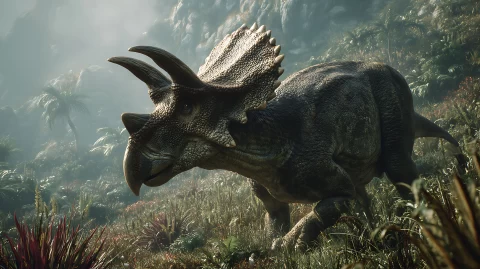
Experience the ancient desert dweller with our stunning 4K wallpaper.
Conclusion
Though it lacked the impressive horns and massive size of its descendants, Protoceratops was a successful dinosaur that thrived in one of the harshest environments of the Cretaceous period. Its abundance in the fossil record and the spectacular "Fighting Dinosaurs" fossil have made it an icon of paleontology. As the ancestor of giants like Triceratops, Protoceratops shows us that even the mightiest lineages had humble beginnings.