Giganotosaurus: The Southern Giant
Move over, T-Rex—South America had its own giant predator. Giganotosaurus was one of the largest carnivorous dinosaurs ever discovered, rivaling and possibly exceeding Tyrannosaurus Rex in size. This massive theropod ruled the ancient landscapes of what is now Argentina during the Late Cretaceous period.
When Did Giganotosaurus Live?
Giganotosaurus lived during the Late Cretaceous period, approximately 98 to 97 million years ago. This was about 30 million years before T-Rex appeared, making Giganotosaurus part of an earlier generation of mega-predators.
Quick Facts
- Period: Late Cretaceous (98-97 million years ago)
- Location: Patagonia, Argentina
- Length: 40-43 feet (12-13 meters)
- Height: 12-13 feet tall at the hips
- Weight: 8-14 tons
- Diet: Carnivore (apex predator)
Bigger Than T-Rex?
The question of whether Giganotosaurus was larger than Tyrannosaurus Rex is hotly debated among paleontologists. Based on current fossil evidence, Giganotosaurus was likely slightly longer and taller, but T-Rex may have been more heavily built and weighed more.
What's clear is that both were absolute giants—apex predators that dominated their respective ecosystems. The key difference is that Giganotosaurus' build suggests it was designed for speed and slashing attacks, while T-Rex was built for crushing bone with sheer bite force.
Built for Hunting Giants
Giganotosaurus lived alongside massive sauropods like Argentinosaurus—some of the largest animals to ever walk on land. Its skull was designed for delivering deep slashing wounds rather than bone-crushing bites. The teeth were blade-like and serrated, perfect for cutting through thick skin and causing massive blood loss.
Pack Hunting?
Some scientists believe Giganotosaurus may have hunted in groups to bring down enormous sauropods. While evidence is limited, the discovery of multiple individuals in close proximity suggests they may have tolerated each other's presence, at minimum. If they did hunt cooperatively, they would have been the only giant theropods known to do so—giving them a crucial advantage over solitary hunters.
Designed for Speed
Despite its massive size, Giganotosaurus was built for relatively quick movement. Its long legs and lighter skull (compared to T-Rex) suggest it could achieve higher running speeds—possibly up to 30 mph in short bursts. This speed would have been essential for hunting the massive, long-necked sauropods that were its primary prey.
A Smaller Brain
One area where T-Rex had a clear advantage was intelligence. Giganotosaurus had a smaller brain relative to its body size than T-Rex, with a brain about the size of a banana. However, this was still more than adequate for a successful predator—Giganotosaurus didn't need exceptional intelligence to hunt slow-moving sauropods.
Discovery in Argentina
Giganotosaurus was discovered in 1993 by amateur fossil hunter Rubén Carolini in Patagonia, Argentina. The discovery sent shockwaves through the paleontology world—here was a predator that challenged T-Rex's title as the largest land predator ever.
Since then, additional specimens and related species (like Mapusaurus) have been found in the same region, revealing that southern South America was home to a lineage of giant predators that evolved separately from the tyrannosaurs of North America and Asia.
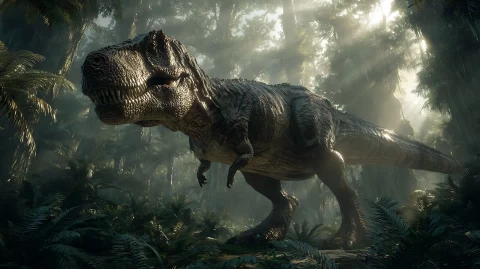
Bring Giganotosaurus to Your Desktop
Experience the southern giant with our stunning 4K wallpaper.
Conclusion
Giganotosaurus proves that T-Rex wasn't the only giant predator to walk the Earth. This massive South American carnivore evolved its own path to apex predator status, specializing in hunting the largest land animals ever known. While it may never achieve T-Rex's fame, Giganotosaurus stands as a testament to the incredible diversity of prehistoric predators—a reminder that every continent had its own terrifying titans.