Deinonychus: The Dinosaur That Changed Everything
In 1964, paleontologist John Ostrom discovered a dinosaur that would revolutionize how scientists understood prehistoric life. Deinonychus—meaning "terrible claw"—was fast, intelligent, and possibly warm-blooded. This discovery helped spark the "Dinosaur Renaissance," transforming dinosaurs from sluggish, cold-blooded reptiles into the dynamic, bird-like creatures we understand them to be today.
When Did Deinonychus Live?
Deinonychus lived during the Early Cretaceous period, approximately 115 to 108 million years ago. It roamed the woodlands and floodplains of what is now Montana, Wyoming, and Oklahoma, sharing its world with early flowering plants and a diverse array of other dinosaurs.
Quick Facts
- Period: Early Cretaceous (115-108 million years ago)
- Location: Western North America (Montana, Wyoming, Oklahoma)
- Length: 11 feet (3.4 meters)
- Height: 3-4 feet tall at the hips
- Weight: 150-220 pounds
- Diet: Carnivore (active predator)
The Terrible Claw
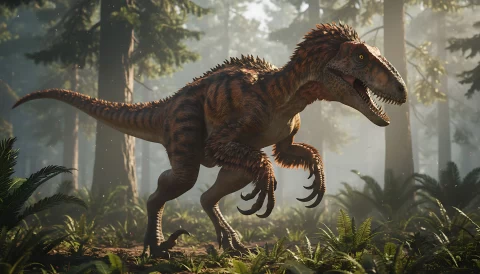
Deinonychus gets its name from the enormous, sickle-shaped claw on the second toe of each hind foot. These claws could reach 5 inches along the outer curve and were the dinosaur's primary weapon. When walking or running, Deinonychus held these claws retracted off the ground, keeping them razor-sharp for hunting.
During an attack, Deinonychus would kick forward with these claws extended, slashing at prey with devastating effect. Some scientists believe the claws were used to pin struggling prey to the ground while the predator delivered killing bites, similar to how modern birds of prey use their talons.
Built for Speed and Agility
Deinonychus was an incredibly agile predator. Its long, stiff tail acted as a dynamic counterbalance, allowing it to make sharp turns at high speed while pursuing prey. Powerful leg muscles and a lightweight build enabled bursts of speed estimated at 25-30 mph.
Unlike the massive, plodding dinosaurs of earlier depictions, Deinonychus was quick, nimble, and built like a predatory bird. Its arms were long and muscular, ending in three-fingered hands with large curved claws perfect for grasping struggling prey.
The Pack Hunting Debate
One of the most famous aspects of Deinonychus is the evidence suggesting it hunted in packs. John Ostrom's original discovery site contained multiple Deinonychus individuals along with a much larger herbivore, Tenontosaurus. This suggested coordinated group hunting of prey much larger than individual predators.
Evidence For and Against
Supporting pack hunting:
- Multiple individuals found with large prey animals
- Relatively large brain suggesting social intelligence
- Modern birds (their descendants) often hunt cooperatively
Challenging pack hunting:
- Individuals may have gathered opportunistically at carcasses rather than hunting together
- Most modern reptiles are solitary hunters
- No definitive proof of coordinated behavior
The truth likely lies somewhere in between—Deinonychus may have had loose social structures, gathering in groups when advantageous but not displaying the complex cooperative behavior of wolves or modern social predators.
The Warm-Blooded Revolution
Ostrom's study of Deinonychus led him to propose a radical idea: some dinosaurs were warm-blooded (endothermic) like modern mammals and birds. The active, agile lifestyle indicated by Deinonychus' anatomy didn't fit with cold-blooded metabolism.
This hypothesis was controversial but revolutionary. It helped establish the connection between dinosaurs and birds, eventually leading to our modern understanding that birds ARE dinosaurs—the only surviving lineage. Today, most scientists believe that many theropods, including Deinonychus, had elevated metabolic rates closer to warm-blooded animals.
Feathered Predator
While no direct fossil evidence of feathers has been found on Deinonychus specimens (the rocks it's found in don't preserve soft tissue well), virtually all paleontologists agree it was feathered. Its close relatives show clear evidence of plumage, and as a member of the dromaeosaur family, Deinonychus almost certainly had feather covering.
These feathers wouldn't have been for flight—Deinonychus was too large and its arms too short. Instead, feathers likely served for insulation (supporting the warm-blooded theory), display, and possibly protecting eggs and young. Imagine a wolf-sized predator covered in brown and rust-colored feathers, and you'll have a more accurate picture than the scaly reptiles of older depictions.
The Jurassic Park Connection
When Michael Crichton wrote "Jurassic Park," he based his "Velociraptors" primarily on Deinonychus. The size, build, and behavior of the movie raptors all match Deinonychus rather than the much smaller Velociraptor. Crichton chose to use the name "Velociraptor" because it sounded more dramatic, but the dinosaurs in the film were essentially Deinonychus in all but name.
This confusion has persisted in popular culture, with many people not realizing that the terrifying pack-hunting raptors of the films were actually modeled on Deinonychus, not Velociraptor.
Scientific Impact
It's hard to overstate the impact Deinonychus had on paleontology. Before its discovery, dinosaurs were viewed as evolutionary failures—slow, stupid, cold-blooded creatures that couldn't compete with mammals. Deinonychus showed they were sophisticated, active predators capable of complex behaviors.
The discovery sparked intense scientific interest in dinosaur biology, metabolism, and evolution. It established the dinosaur-bird connection that is now fundamental to our understanding of both groups. In many ways, Deinonychus bridges the gap between our old conception of dinosaurs and our modern understanding of them as dynamic, diverse, and evolutionarily successful animals.
Bring Deinonychus to Your Desktop
Experience the revolutionary raptor with our stunning 4K wallpaper.
Conclusion
Deinonychus wasn't just another predatory dinosaur—it was the dinosaur that changed how we see all dinosaurs. From challenging the cold-blooded reptile stereotype to establishing the bird-dinosaur connection, Deinonychus sparked a scientific revolution that continues today. This "terrible claw" predator proved that dinosaurs weren't evolutionary dead-ends but sophisticated, successful animals whose descendants still fly above us today.