Ankylosaurus: The Armored Tank of the Cretaceous
Imagine a living tank covered in thick bony plates, wielding a massive club at the end of its tail. That's Ankylosaurus, one of the most heavily armored creatures to ever walk the Earth. This remarkable herbivore survived in a world dominated by fearsome predators like Tyrannosaurus Rex, relying on its incredible natural armor and devastating tail weapon for protection.
When Did Ankylosaurus Live?
Ankylosaurus lived during the Late Cretaceous period, approximately 68 to 66 million years ago—making it one of the last dinosaurs to exist before the mass extinction event. It shared its world with other famous Late Cretaceous dinosaurs including T-Rex, Triceratops, and various species of hadrosaurs (duck-billed dinosaurs).
Quick Facts
- Period: Late Cretaceous (68-66 million years ago)
- Location: Western North America
- Length: 20-26 feet (6-8 meters)
- Height: 5.5 feet tall at the hips
- Weight: 4-8 tons
- Diet: Herbivore (plant-eater)
Nature's Perfect Armor
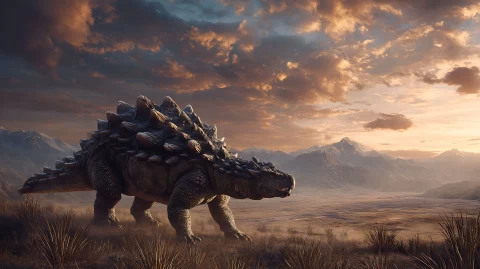
Ankylosaurus was built like a biological fortress. Its entire back, sides, and even its eyelids were covered in thick, bony plates called osteoderms—the same type of armor found on modern crocodiles, but far more extensive and robust. These plates were embedded in its tough skin, creating an nearly impenetrable shield against predators.
The armor wasn't just plates—it included rows of spikes protruding from its body, making it even more difficult for predators to get a grip or inflict damage. Even the top of its head was armored with thick bone, protecting its brain from attacks.
The Devastating Tail Club
The most famous feature of Ankylosaurus is its tail club—a massive bony knob at the end of its tail that could weigh over 60 pounds (30 kg). This wasn't just for show. Scientists estimate that Ankylosaurus could swing this club with tremendous force, capable of breaking bones or even crushing the leg of an attacking T-Rex.
The tail club was composed of several large osteoderms fused together with the last tail vertebrae, creating a solid, handle-like structure. Powerful muscles along the tail allowed Ankylosaurus to swing this weapon from side to side with devastating effect.
Life as a Walking Fortress
Despite its fearsome defenses, Ankylosaurus was a peaceful herbivore. It likely spent its days browsing on low-growing vegetation, using its wide beak to crop plants close to the ground. Its teeth were small and leaf-shaped, designed for processing soft plant material rather than tough vegetation.
With its low-slung, wide body and short legs, Ankylosaurus was not built for speed. Instead, it relied entirely on its armor and tail club for defense. When threatened, it probably crouched down, protecting its vulnerable underbelly, and used its tail to ward off attackers.
Habitat and Environment
Ankylosaurus lived in the same Hell Creek Formation habitat as T-Rex and Triceratops—the coastal lowlands and floodplains of western North America during the Late Cretaceous. This region had a subtropical climate with:
- Dense forests of conifers and early flowering plants
- Wide river systems and coastal swamps
- Seasonal rainfall patterns
- Temperatures warmer than modern-day Montana and Wyoming
Discovery and Scientific Importance
The first Ankylosaurus fossils were discovered in 1906 by paleontologist Barnum Brown (the same scientist who found the first T-Rex). However, complete skeletons are extremely rare—we still don't have a fully intact specimen. Most of our knowledge comes from partial skeletons and isolated armor plates.
Despite the incomplete fossil record, Ankylosaurus has become an icon of dinosaur defensive adaptations. It represents the ultimate expression of the ankylosaur family—a group that evolved increasingly sophisticated armor over millions of years.
Bring Ankylosaurus to Your Desktop
Experience the armored majesty of Ankylosaurus with our stunning 4K wallpaper.
Conclusion
Ankylosaurus stands as nature's answer to the ultimate defense challenge. In a world filled with apex predators, this remarkable dinosaur evolved armor so effective that it survived until the very end of the Age of Dinosaurs. Its combination of protective plating and offensive weaponry represents one of evolution's most impressive defensive systems—a walking fortress that has captured our imagination for over a century.