Allosaurus: The Lion of the Jurassic
Before Tyrannosaurus Rex dominated the Cretaceous, there was Allosaurus—the apex predator of the Late Jurassic period. Often called "the lion of the Jurassic," Allosaurus was smaller than T-Rex but no less fearsome. With powerful jaws, razor-sharp teeth, and exceptional agility, this carnivore ruled the ancient landscapes of North America for millions of years.
When Did Allosaurus Live?
Allosaurus lived during the Late Jurassic period, approximately 155 to 145 million years ago. This was the golden age of dinosaurs, when massive sauropods like Brachiosaurus and Diplodocus roamed the Earth, and Allosaurus sat firmly at the top of the food chain as the most common large predator of its time.
Quick Facts
- Period: Late Jurassic (155-145 million years ago)
- Location: Western North America (Colorado, Utah, Wyoming)
- Length: 28-32 feet (8.5-9.5 meters)
- Height: 10 feet tall at the hips
- Weight: 2-2.5 tons
- Diet: Carnivore (apex predator)
Built for the Hunt
Allosaurus was a perfectly designed killing machine. Unlike the massive, bone-crushing jaws of T-Rex, Allosaurus had a lighter, more flexible skull that allowed it to open its mouth extremely wide—nearly 90 degrees. Its teeth were blade-like, with serrated edges designed to slice through flesh rather than crush bone.
Hunting Strategy
Scientists believe Allosaurus used a unique hunting technique called the "hatchet attack." It would strike prey with its upper jaw like an axe, using the weight of its head and powerful neck muscles to deliver devastating slashing wounds. This allowed it to take down prey much larger than itself, including giant sauropods.
Fossil evidence shows that Allosaurus frequently hunted Stegosaurus—perhaps its most dangerous prey. Paleontologists have found Allosaurus fossils with wounds that match Stegosaurus tail spikes, suggesting these battles were fierce and sometimes fatal for the predator.
Pack Hunter or Lone Wolf?
One of the most debated questions about Allosaurus is whether it hunted alone or in packs. Evidence points both ways. Multiple Allosaurus fossils have been found together at sites like the Cleveland-Lloyd Dinosaur Quarry in Utah, suggesting they may have gathered at kill sites or hunted cooperatively.
However, many scientists believe these gatherings were more likely feeding frenzies around a dead sauropod rather than coordinated pack hunting. Like modern Komodo dragons, Allosaurus may have been opportunistic feeders that tolerated each other's presence when food was abundant.
Physical Characteristics
Allosaurus was built for speed and agility rather than raw power. Its long, muscular tail provided balance, allowing it to make quick turns while running. Three-fingered hands equipped with large, curved claws could grasp and hold struggling prey. Unlike T-Rex's tiny arms, Allosaurus had functional forelimbs that played an active role in hunting.
Above each eye, Allosaurus had distinctive bony ridges—likely for display or to protect its eyes during violent feeding. These "horns" have led some paleontologists to speculate that males may have engaged in head-butting contests for dominance or mates.
The Morrison Formation
Allosaurus fossils are most abundant in the Morrison Formation, a fossil-rich geological formation spanning several western U.S. states. This ancient environment was a semi-arid landscape with seasonal rivers, floodplains, and conifer forests—very different from the lush tropical environments often depicted in popular media.
The Morrison Formation has yielded more Allosaurus specimens than any other large predator from any time period, making it one of the best-understood carnivorous dinosaurs. Hundreds of bones from dozens of individuals have been found, ranging from juveniles to full-grown adults.
Discovery and Scientific Legacy
The first Allosaurus fossil was discovered in 1877 by paleontologist Othniel Charles Marsh during the famous "Bone Wars"—a bitter rivalry between Marsh and Edward Drinker Cope that led to the discovery of many iconic dinosaurs. Since then, Allosaurus has become one of the most studied dinosaurs, with numerous complete skeletons helping scientists understand theropod evolution and behavior.
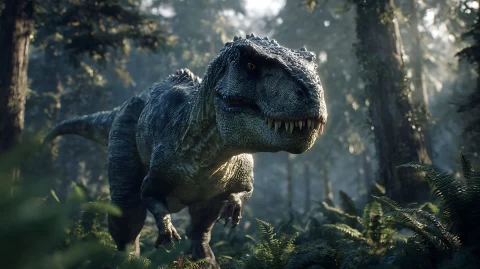
Bring Allosaurus to Your Desktop
Experience the predatory power of Allosaurus with our stunning 4K wallpaper.
Conclusion
Allosaurus represents the pinnacle of Jurassic predatory evolution. For millions of years, this magnificent carnivore ruled its ecosystem with a combination of speed, agility, and devastating hunting techniques. Though it lived 80 million years before T-Rex, Allosaurus proved that apex predators don't need massive size to dominate—sometimes, efficiency and adaptation are the keys to evolutionary success.